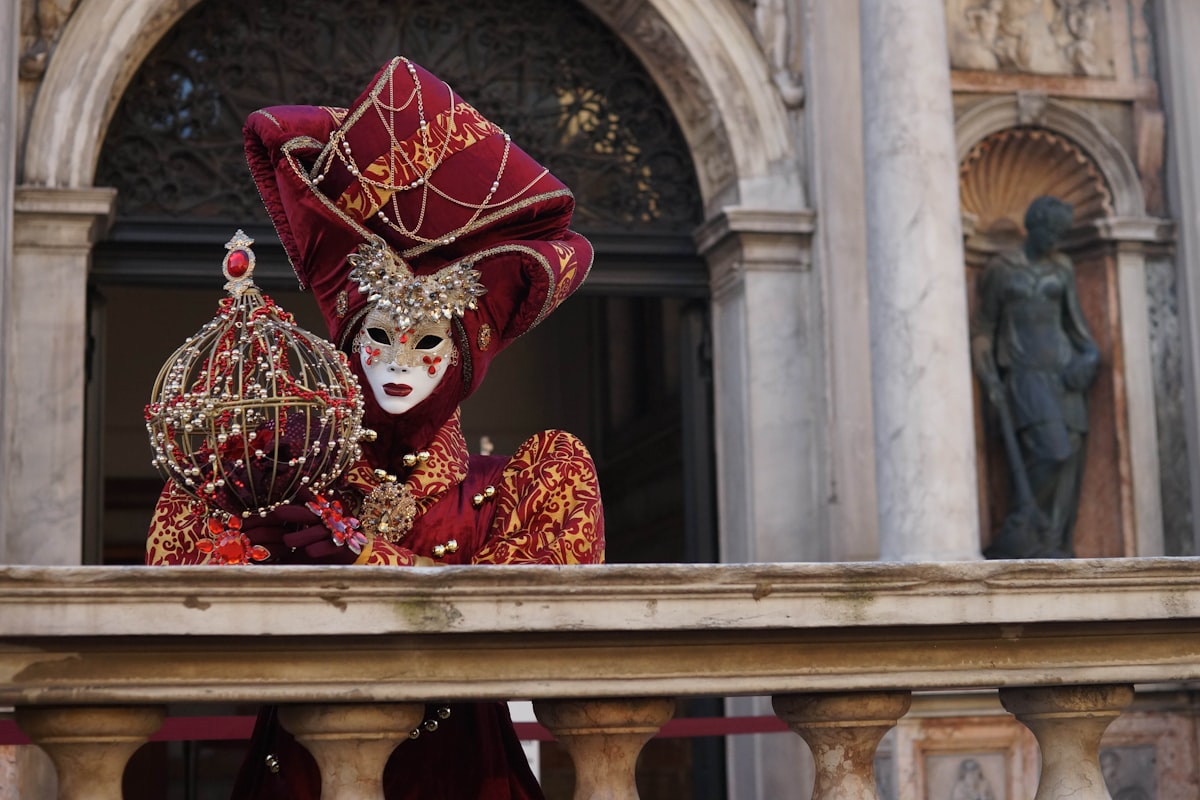
The first thing you notice is the silence around the costumes. I expected noise, music, revelry — and there is plenty of that in the side streets and bars. But the people in the elaborate full-body costumes, the ones dripping with brocade and hand-painted masks, move through the piazzas without speaking. They stop, they pose, they hold a gesture for twenty seconds while forty cameras click, and then they glide away. It's closer to performance art than a party. Unsettling, beautiful, and nothing like what the photos on social media suggest.
I've been to Venice Carnival three times now — in 2016, 2019, and again in 2024. Each time I've come away with contradictory feelings. The spectacle is extraordinary. The crowds are suffocating. The masked figures are haunting. The souvenir stalls are tacky beyond belief. It is simultaneously the most photogenic and the most exhausting week Venice has to offer.
In This Article
Dates: It Moves Around, Like Easter
Venice Carnival runs for roughly two and a half weeks, ending on Shrove Tuesday (Martedì Grasso). Since that date depends on Easter, the festival shifts each year. Generally, it falls in February, sometimes spilling into late January or early March.
For 2026, Carnival runs from approximately 7 to 17 February. The busiest days are always the two weekends and the final Tuesday. Weekdays during Carnival are noticeably calmer — the locals joke that you can actually walk through San Marco on a Carnival Wednesday, which tells you something about what the weekends are like.
What Actually Happens
The short answer: a lot, spread across the city, with varying degrees of organisation.
The main events you'll encounter:
- The Volo dell'Angelo (Flight of the Angel) — the opening Sunday. A performer descends on a zip line from the top of the Campanile to the stage in Piazza San Marco. Spectacular, packed, and over in about two minutes. Get there at least ninety minutes early if you want to see anything.
- Festa delle Marie — a procession of twelve young women in historical costumes, parading from San Pietro di Castello to San Marco. It commemorates a 10th-century event when Venetian brides were kidnapped by Istrian pirates. Venice has always been good at turning historical trauma into pageantry.
- Costume competitions — held in the piazza, usually the second weekend. The costumes that compete here are extraordinary — multi-layered, historically researched, some costing thousands of euros. The judges are genuinely expert.
- The Water Parade — a flotilla of decorated boats along the Rio di Cannaregio on the opening Saturday. Less famous than the piazza events but, in my opinion, more atmospheric.
- Street performances — fire-eaters, musicians, acrobats, scattered across the city. Variable in quality. Some are genuinely good; some are doing the same juggling act you'd see at any European Christmas market.
The unofficial spectacle, though, is better than any programme. The costumed figures — known as maschere — simply appear. You'll round a corner in Dorsoduro and find a figure in a full Plague Doctor costume standing alone on a bridge, silhouetted against the canal. Or you'll walk into a campo and discover a trio of 18th-century aristocrats posing for a photographer in the morning mist. These moments are unrehearsed, free, and genuinely strange.
The Free Stuff Versus the €500 Masked Balls
Most of Carnival is free. The parades, the piazza events, the street performances, the general atmosphere of wandering through a city full of masked strangers — all of it costs nothing beyond your travel and accommodation (though accommodation prices during Carnival are, it should be said, eye-watering).
Then there are the masked balls.
| Experience | Cost | What You Get |
|---|---|---|
| Free piazza events | €0 | Parades, costume watching, atmosphere |
| Basic ball / party | €200–350 | Venue entry, mask, one drink, dancing |
| Mid-range gala | €350–500 | Palace venue, dinner, open bar, live music |
| Grand ball (e.g. Ballo del Doge) | €500–1,500+ | Major palazzo, multi-course dinner, full costume dress code |
The balls are held in actual Venetian palazzi — candlelit rooms, frescoed ceilings, orchestras playing Vivaldi. The most famous, the Ballo del Doge at Palazzo Pisani Moretta, charges upwards of €500 per person and requires a full historical costume. It is, by all accounts, magnificent and absurd in equal measure. I've never been. A photographer's salary doesn't stretch to that kind of absurdity.
I did attend a mid-range event in 2019 — about €300, at a palazzo near Campo Santo Stefano. It was enjoyable in the way that fancy dress parties are always enjoyable: slightly awkward at first, then surprisingly fun once you've had enough prosecco to stop feeling self-conscious about wearing a mask indoors. The venue was beautiful. The food was mediocre. The people-watching was outstanding.
You don't need a ball to experience Carnival. You just need to walk through the city with your eyes open. The free spectacle is, honestly, better than most of the paid events.
The Mask Question: Tourist Tat or the Real Thing?
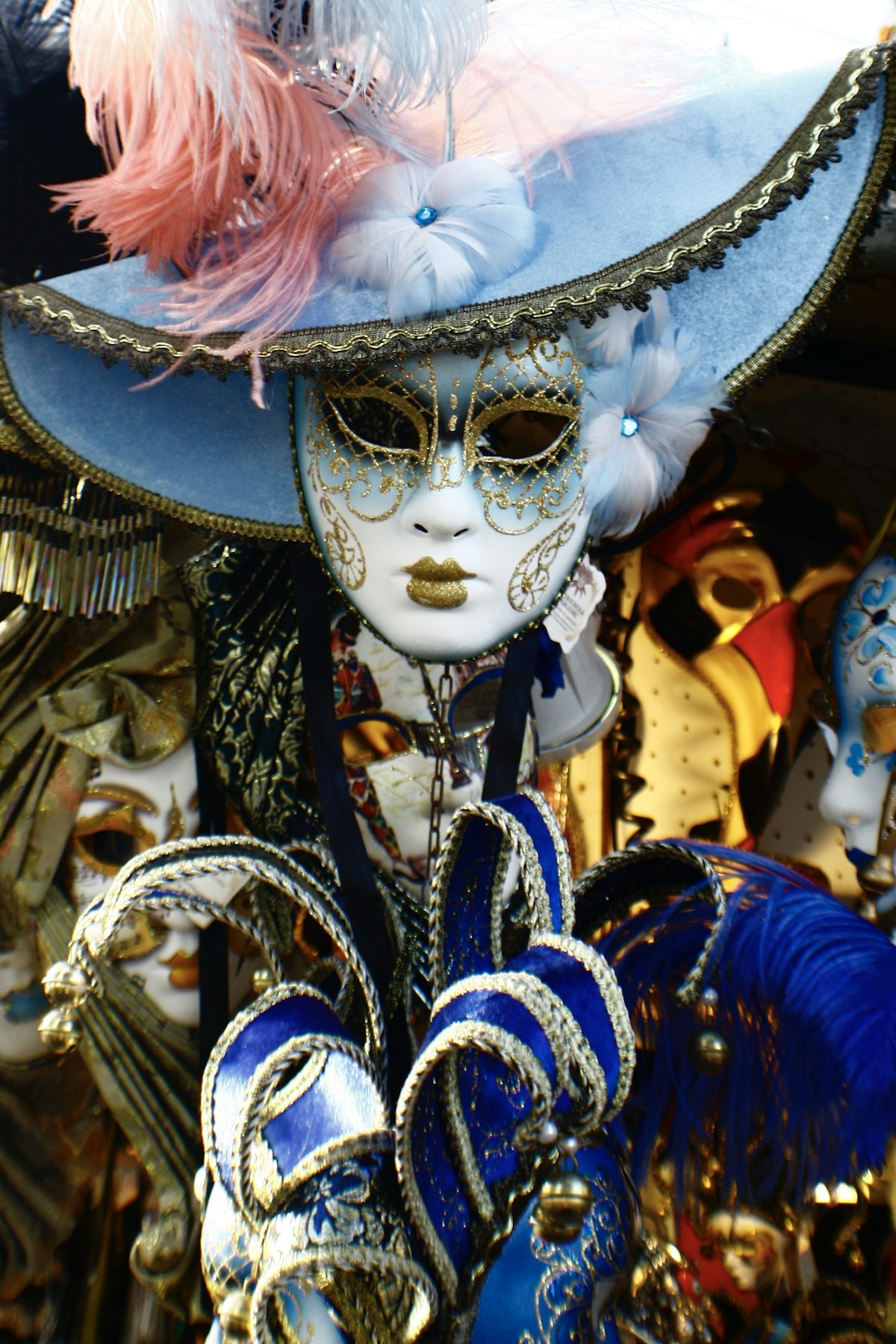
The souvenir shops sell masks for €5–15. They're made in China, they look like it, and they'll fall apart within a week. If you want something to hang on a wall as a memento, fine. If you want something with any artistic merit, you'll need to visit an actual maskmaker.
Venice still has a handful of genuine artisan mask workshops — mascherari — and the difference between their work and the factory imports is the difference between a painting and a poster.
- Ca' Macana (Dorsoduro) — probably the most famous workshop. They made masks for the Kubrick film Eyes Wide Shut. Prices from €40 for simple designs to several hundred for elaborate pieces. They also run mask-painting workshops (about €75, 90 minutes).
- Tragicomica (near Campo San Tomà) — specialises in Commedia dell'Arte characters. Beautiful work, knowledgeable owners, prices from €50.
- La Bottega dei Mascareri (at the foot of the Rialto Bridge, San Polo side) — two brothers who've been making masks here since the 1980s. Smaller workshop, more personal experience.
The traditional mask types each have names and histories. The bauta is the angular white mask that covers the whole face, designed so you can eat and drink without removing it. The moretta was a black velvet oval held in place by biting a button — meaning the wearer literally couldn't speak. The medico della peste (plague doctor) with its long beak was a real medical device filled with herbs and spices, meant to filter infected air. It didn't work, obviously, but the design survived as one of the most recognisable masks in the world.
Photographing Carnival — Notes from a Professional
Carnival is photographically extraordinary and frustrating in roughly equal proportion.
The extraordinary part: the costumes, the light, the architectural backdrops. Venice was designed to be looked at, and during Carnival the human subjects match the setting. A figure in full 17th-century costume standing on a fog-shrouded bridge at dawn is the kind of image that can define a portfolio.
The frustrating part: everyone else is also taking that photo. Including the person behind you whose phone is in your shot, and the person in front of you who won't move, and the tour group that has somehow inserted itself between you and your subject.
A 70-200mm lens is useful for isolating figures against blurred architectural backgrounds. But I've also got images I love shot on a 35mm — the ones that include the context, the crowd, the whole surreal scene. Both approaches work. Just avoid flash; the masks look better in natural light, and the costumed figures will visibly recoil if you fire a strobe in their face.
Surviving the Crowds
During Carnival weekends, Venice can receive 100,000+ daily visitors on top of its resident population of about 50,000. The maths is uncomfortable. The vaporetti are packed to a degree that would violate any reasonable fire code. The narrow calli become one-way rivers of people. Getting from Rialto to San Marco — normally a 15-minute walk — can take 40 minutes.
Practical survival notes:
- Book accommodation months ahead. Prices during Carnival are 2–3 times higher than normal. A hotel that charges €120 in January will charge €300+ during the festival.
- The vaporetto is unusable on Carnival Saturdays. Walk everywhere, or take the less obvious routes through Dorsoduro and Castello.
- Eat lunch early (before noon) or late (after 2pm). Every restaurant near San Marco will have a queue during peak hours.
- Keep valuables secure. Pickpocketing increases significantly during Carnival — the crowds and the distraction of the costumes make it easy for light fingers.
Weekdays are genuinely different. I spent a Carnival Tuesday in 2024 wandering through Cannaregio and barely encountered a crowd. The costumed figures were still around, but you could actually see them, talk to them, photograph them without being jostled. If you can take time off work, a Carnival weekday is the way to do it.
So, Is It Worth Building a Trip Around?
Honestly? Go once.
Venice Carnival is one of those events that belongs on the list of things you should experience if you have any interest in European culture, theatre, history, or photography. The visual spectacle is real. The atmosphere — that strange mix of celebration and melancholy, of revelry and formality — is unlike anything else I've encountered. And the masks, the proper ones, are genuinely beautiful objects.
But I wouldn't organise every Venice trip around it. The city during Carnival is not the city I fell in love with. It's a version of itself — heightened, theatrical, overcrowded. If you've never been to Venice, I'd argue strongly that your first visit should be in low season, when you can hear your own footsteps in the streets and see the facades without ten thousand selfie sticks in the foreground. Come for Carnival on your second or third trip, when you already know the back streets and have your favourite cicchetti bar to retreat to when the piazza gets unbearable.
For more on when to visit Venice, including quieter alternatives to the Carnival period, I've written a month-by-month breakdown. And if you're planning your route from the airport during what will be one of Venice's busiest weeks, the transfer guide covers all the options.